Showing posts with label tenth. Show all posts

Monday, February 10, 2020

Interactive class

Task 1)
Review topic:
Use Google search (wiki) to complete the following quiz. Take notes in your notebook.
http://www2.yvcc.edu/Biology/230Modules/BIOL230Modules/multi_dropquiz/glands.html

Resultado de imagen para hormones

Task 2)
Current topic:
Use the following link to see cell organelles in detail. Note some key differences between different types of cells in your notebook.
https://askabiologist.asu.edu/cell-viewer-game/play.html

Resultado de imagen para difference between plant animal fungal and bacterial cells

Task 3) (Optional)
Using the same link as above, see other topics and make notes.


Monday, January 20, 2020

Cells


·       Nearly all plants and animals are made up of thousands or millions of microscopic (organs/cells/organelles).
·       All cells contain (blood, cytoplasm, cell wall) enclosed in a cell membrane.
·       (All/most/some) cells have a nucleus.
·       Many chemical reactions take place in the (xylem/vessels/cytoplasm) to keep the cell alive.
·       The nucleus directs the chemical reactions in the cell and also controls cell division/cell membrane/food stores).
·       Plant cells have a cellulose cell wall and a large central (Golgi body/Endoplasmic reticulum/vacuole).
·       Cells are often specialised in their (colour/shape/texture) and activity to carry out particular jobs.
·       Large numbers of similar cells packed together form a (body/organism/tissue).
·       Different tissues arranged together form (organs/organ systems/organisms).
·       A group of related organs makes up a (system/tank/reservoir).
·       The (colour/magnification/clarity) of a specimen can be calculated if the actual size and the size of the image are known.
·       Cytoplasm contains (vacuoles/ribosomes/organelles) such as mitochondria, chloroplasts and ribosomes.
·       The magnification and size of biological specimens can be calculated using millimetres or (picometres/micrometres/metres).


Answers:


·       Nearly all plants and animals are made up of thousands or millions of microscopic (organs/cells/organelles).
·       All cells contain (blood, cytoplasm, cell wall) enclosed in a cell membrane.
·       (All/most/some) cells have a nucleus.
·       Many chemical reactions take place in the (xylem/vessels/cytoplasm) to keep the cell alive.
·       The nucleus directs the chemical reactions in the cell and also controls cell division/cell membrane/food stores).
·       Plant cells have a cellulose cell wall and a large central (Golgi body/Endoplasmic reticulum/vacuole).
·       Cells are often specialised in their (color/shape/texture) and activity to carry out particular jobs.
·       Large numbers of similar cells packed together form a (body/organism/tissue).
·       Different tissues arranged together form (organs/organ systems/organisms).
·       A group of related organs makes up a (system/tank/reservoir).
·       The (colour/magnification/clarity) of a specimen can be calculated if the actual size and the size of the image are known.
·       Cytoplasm contains (vacuoles/ribosomes/organelles) such as mitochondria, chloroplasts and ribosomes.
·       The magnification and size of biological specimens can be calculated using millimetres or (picometres/micrometres/metres).


Monday, December 9, 2019

Unit 3


  • Diffusion is the result of molecules of liquid, gas or dissolved solid moving about. 

• The molecules of a substance diffuse from a region where they are very concentrated to a region where they are less concentrated.
• Substances may enter cells by simple diffusion, controlled diffusion or active transport.
• Osmosis is the diffusion of water through a partially permeable membrane, from a dilute solution of salt or sugar to a concentrated solution because the concentrated solution contains fewer free water molecules.
• Cell membranes are partially permeable and cytoplasm and cell sap contain many substances in solution.
• Cells take up water from dilute solutions but lose water to concentrated solutions because of osmosis.
• Osmosis maintains turgor in plant cells.
• Active transport involves the movement of substances against their concentration gradient. • Active transport requires energy.
• Kinetic energy of molecules and ions results in their diffusion.
• Osmosis involves the diffusion of water from a region of higher water potential to a region of lower water potential through a partially permeable membrane.
• The meanings of the terms turgid, turgor pressure, plasmolysis and flaccid.
• The importance of water potential and osmosis to animal and plant cells.
• Turgor pressure in cells provides support in plants.
• Active transport is important as it allows movement of substances across membranes against a concentration gradient.

Unit 2


  •  Nearly all plants and animals are made up of thousands or millions of microscopic cells. 
  •  All cells contain cytoplasm enclosed in a cell membrane.
  • Most cells have a nucleus.
  • Many chemical reactions take place in the cytoplasm to keep the cell alive.
  • The nucleus directs the chemical reactions in the cell and also controls cell division.
  • Plant cells have a cellulose cell wall and a large central vacuole.
  • Cells are often specialised in their shape and activity to carry out particular jobs.
  • Large numbers of similar cells packed together form a tissue.
  • Different tissues arranged together form organs.
  • A group of related organs makes up a system. 
  • The magnification of a specimen can be calculated if the actual size and the size of the image are known. 
  • Cytoplasm contains organelles such as mitochondria, chloroplasts and ribosomes.
  • The magnification and size of biological specimens can be calculated using millimetres or micrometres.

Wednesday, December 4, 2019

Unit 1

Key definitions

  1. Movement is an action by an organism causing a change of position or place (see Chapter 14). 
  2. Respiration describes the chemical reactions in cells that break down nutrient molecules and release energy (see Chapter 12). 
  3. Sensitivity is the ability to detect and respond to changes in the environment (see Chapter 14).
  4. Growth is a permanent increase in size (see Chapter 16). 
  5. Reproduction is the processes that make more of the same kind of organism (see Chapter 16). Single-celled organisms and bacteria may simply keep dividing into two. Multicellular plants and animals may reproduce sexually or asexually. 
  6. Excretion is the removal from organisms of toxic materials and substances in excess of requirements (see Chapter 13). 
  7. Nutrition is the taking in of materials for energy, growth and development (see Chapters 6 and 7).
Key definitions 
  1. A species is a group of organisms that can reproduce to produce fertile offspring. 
  2. The binomial system is an internationally agreed system in which the scientific name of an organism is made up of two parts showing the genus and the species. The Latin form of the name allows it to be used in all the countries of the world irrespective of language barriers.
  3. Archaea: containing ancient prokaryotic organisms which do not have a nucleus surrounded by a membrane. They have an independent evolutionary history to other bacteria and their biochemistry is very different to other forms of life.
  4. Eubacteria: prokaryotic organisms which do not have a nucleus surrounded by a membrane.
  5. Eukarya: organisms that have a membrane-bound nucleus. This domain is further subdivided into the kingdoms Protoctist, Fungus, Plant and Animal.


Thursday, September 5, 2019

Control and Cordination


The Eye

Resultado de imagen para rod and cone cells
The eye 

The sclera is the tough, white outer coating. The front part of the sclera is clear and allows light to enter the eye. This part is called the cornea. The conjunctiva is a thin epithelium, which lines the inside of the eyelids and the front of the sclera and is continuous with the epithelium of the cornea. The eye contains a clear liquid whose outward pressure on the sclera keeps the spherical shape of the eyeball. The liquid behind the lens is jelly-like and called vitreous humour. The aqueous humour in front of the lens is watery. The lens is a transparent structure, held in place by a ring of fibres called the suspensory ligament. Unlike the lens of a camera or a telescope, the eye lens is flexible and can change its shape. In front of the lens is a disc of tissue called the iris. It is the iris we refer to when we describe the colour of the eye as brown or blue. The iris controls how much light enters the pupil, which is a hole in the centre of the iris. The pupil lets in light to the rest of the eye. The pupil looks black because all the light entering the eye is absorbed by the black pigment in the choroid. The choroid layer, which contains many blood vessels, lies between the retina and the sclera. In the front of the eyeball, it forms the iris and the ciliary body. The ciliary body produces aqueous humour. The internal lining at the back of the eye is the retina and it consists of many thousands of cells that respond to light. When light falls on these cells, they send off nervous impulses, which travel in nerve fibres, through the optic nerve, to the brain and so give rise to the sensation of sight. The part of the retina lying directly in front of the optic nerve contains no lightsensitive cells. This region is called the blind spot. Tear glands under the top eyelid produce tear fluid. This is a dilute solution of sodium chloride and sodium hydrogencarbonate. The fluid is spread over the eye surface by the blinking of the eyelids, keeping the surface moist and washing away any dust particles or foreign bodies. Tear fluid also contains an enzyme, lysozyme, which attacks bacteria. 


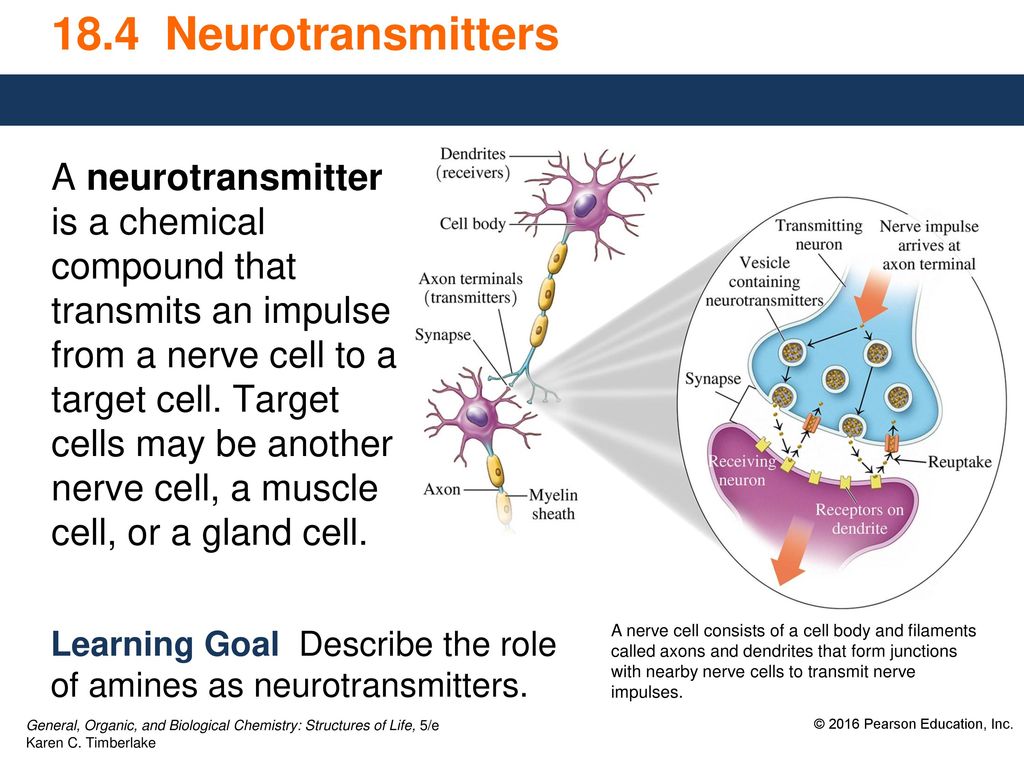
Neurotransmitters

Resultado de imagen para neurotransmitters

Resultado de imagen para neurotransmitters

Resultado de imagen para neurotransmitters


10 Scientific Facts About Neurotransmitters that you Might Not Know
Neurotransmitters also referred as chemical messengers, assist the brain in managing the tissues and functions of the body through muscles and organs.

1.      There are more than 100 types of chemical messengers in the body.
2.      Large proteins usually size around 10nm, this means that normally neurotransmitters would size around 0.5 to 5 nanometers.
3.      Glutamate is the most abundant neurotransmitter found.
4.      The first neurotransmitter to be discovered is Acetylcholine. It is a kind of neurotransmitter which is mainly responsible for activating muscles.
5.      Dopamine is another major neurotransmitter responsible for monitoring the memory and motor control. When the level of dopamine is elevated it may result in hyperactivity and anxiety. It may further experience mood swings, attention disorders, autism etc. Dopamine injections are used to recover the conditions occurred when you are in shock or the conditions which are caused by surgery, trauma or kidney failure. 
6.      Norepinephrine is an excitatory chemical messenger that is majorly responsible for processes of focus and attention. It is also known as the stress hormone. 
7.      GABA is a kind of inhibitory neurotransmitter; it is a significant neurotransmitter that aids the conversion of messages between nervous system and brain. The main function of GABA is to reduce excitability, improve sleep and decrease inflammation.
8.      Epinephrine is another excitatory neurotransmitter that regulates metabolism and blood pressure. It functions primarily to raise glucose levels in the blood. 
9.      Glutamate is a chemical that is used by nerve cells to send signals to other cells. It is considered as the major mediatory of the signals in CNS and is equally involved in the brain functioning including memory, cognition, and learning.
10.  Glycine is present in the brain stem and spinal cord and participates in sensor and motor functions. Glycine act as a building block for protein.
Name all the eight neurotransmitters mentioned. What effect do they have on us?
Can you name any more neurotransmitters?


Brain Lobes

Cultures